

Salmon Protein Hydrolysate Market to Hit USD 740 Million by 2036 Driven by Rapid Absorption & Marine Upcycling
Salmon Protein Hydrolysate
Salmon Protein Hydrolysate Market Rising demand for bioavailable peptides, sustainable sourcing, functional nutrition is reshaping global ingredient strategies.
DELAWARE, NY, UNITED STATES, March 19, 2026 /EINPresswire.com/ -- The global functional nutrition landscape is undergoing a structural transformation, with salmon protein hydrolysate emerging as a high-value ingredient driven by rapid absorption, sustainability, and precision nutrition. As consumers and formulators increasingly prioritize bioavailable protein sources over conventional intact proteins, hydrolyzed marine peptides are transitioning from niche clinical applications to mainstream functional food and beverage formulations.
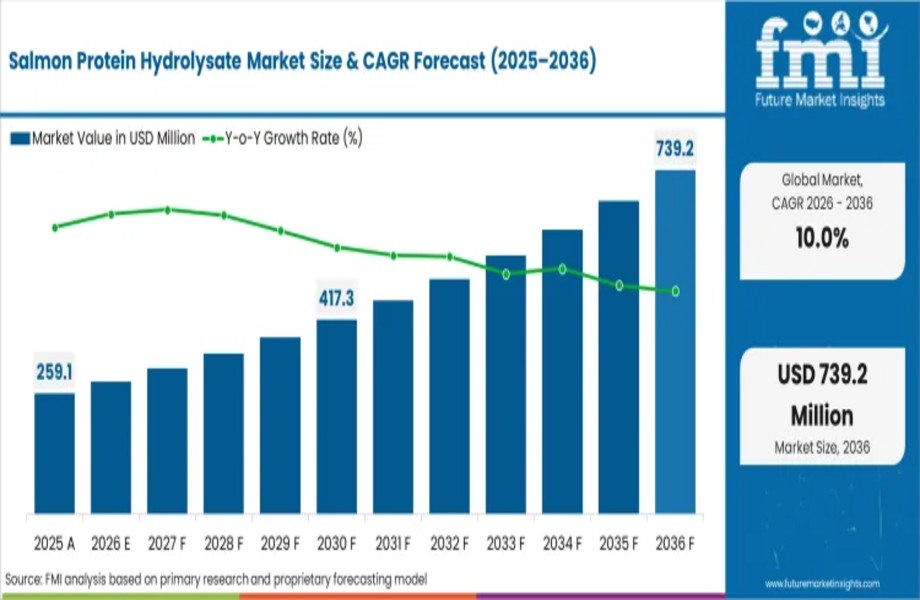
According to a comprehensive strategic outlook released by Future Market Insights (FMI), the global Salmon Protein Hydrolysate Market is projected to grow from USD 285.0 million in 2026 to USD 740.0 million by 2036, reflecting a CAGR of 10.0%. The market has already surpassed USD 260.0 million in 2025, highlighting strong momentum driven by increasing adoption across sports nutrition, medical nutrition, and active lifestyle segments.
This growth reflects a structural shift toward value-added marine ingredients, where rapid amino acid delivery, sustainability, and clinical efficacy are redefining procurement and formulation strategies.
Get Access to the Full Report Sample: Explore detailed forecasts, segment insights, and competitive analysis: https://www.futuremarketinsights.com/reports/sample/rep-gb-32126
The Shift Toward High-Absorption Marine Nutrition
Salmon protein hydrolysate is gaining traction as formulation teams move away from traditional protein concentrates toward pre-digested peptide formats that offer superior absorption kinetics.
Growth is being driven by:
Rising demand for clinically effective, fast-absorbing protein sources
Increasing utilization of fisheries by-products for high-value applications
Expansion of functional foods and ready-to-consume nutritional formats
Processors are transforming secondary biomass into premium ingredients, converting waste streams into profitable revenue channels while supporting circular economy goals.
Market Transformation Driven by Sustainability and Upcycling
The market is structurally aligned with global sustainability trends, particularly the upcycling of marine biomass.
Fisheries and aquaculture production reached record levels, ensuring abundant raw material supply
Processors are investing in enzymatic hydrolysis technologies to extract high-purity peptides
Brands are leveraging clean-label marine ingredients to differentiate premium offerings
This shift is redefining marine supply chains, moving from waste management toward optimized nutrition extraction.
Key Market Insights for Decision Makers
High Growth Trajectory: The market is expected to expand at a CAGR of 10.0%, driven by performance nutrition demand
Form Leadership: Powder formats dominate with a 53% share due to stability, transport efficiency, and ease of integration
Application Dominance: Functional foods & beverages account for 32% of total demand, reflecting mainstream adoption
Sustainability Advantage: Upcycled marine peptides provide both economic and environmental benefits
Segment Insights: Powder Formats and Functional Applications Lead
Powder-based salmon protein hydrolysate remains the preferred format due to logistical and formulation advantages:
Extended shelf life without cold chain requirements
Lower transportation costs due to reduced weight
Compatibility with existing dry blending manufacturing systems
On the application side, functional foods and beverages are leading growth, as brands incorporate marine peptides into:
Ready-to-drink beverages
Protein bars
Nutritional supplements This trend reflects a broader shift away from pills toward everyday nutrition formats with measurable health benefits.
Regional Dynamics: Asia-Pacific Emerges as a High-Growth Hub
Global demand is expanding across key regions where aquaculture capacity intersects with rising nutrition awareness:
India (12.0% CAGR): Strong seafood processing ecosystem and growing functional nutrition demand
China (11.2% CAGR): Increased adoption in aquafeed and immune-support formulations
United States (10.4% CAGR): High demand for clinically validated performance nutrition
United Kingdom (9.8% CAGR) and Germany (9.5% CAGR): Growth driven by aging populations and nutraceutical demand
Brazil (9.1% CAGR): Expanding agricultural and aquaculture applications
Asia-Pacific is emerging as both a production and consumption hub, supported by large-scale aquaculture operations and improving downstream integration.
Competitive Landscape: Science-Led Differentiation Gains Importance
The competitive environment is shaped by technological capability, clinical validation, and supply chain integration.
Key success factors include:
Precision enzymatic processing and peptide standardization
Clinical trials to validate absorption and health benefits
Vertical integration with aquaculture supply chains
Strategic partnerships to expand global distribution
Companies investing in molecular profiling and batch-level consistency are expected to move beyond commodity positioning into premium, science-backed nutrition segments.
Strategic Takeaway for Executives
As salmon protein hydrolysate evolves into a core ingredient in performance nutrition, the opportunity lies in aligning sustainability with scientific validation.
Companies that prioritize:
Long-term raw material sourcing partnerships
Clinical substantiation of health claims
Expansion of powder processing capacity
Integration into mainstream food and beverage formats
will be best positioned to capture premium margins and long-term growth.
𝗪𝗵𝘆 𝗙𝗠𝗜: https://www.futuremarketinsights.com/why-fmi
Frequently Asked Questions (FAQs)
How large is the salmon protein hydrolysate market in 2026?
The market is projected to reach USD 285.0 million in 2026.
What will the market be valued at by 2036?
The market is expected to reach USD 740.0 million by 2036.
What is the expected CAGR?
The market is forecast to grow at a CAGR of 10.0% between 2026 and 2036.
Which segment leads the market?
Powder format leads with a 53% share due to stability and ease of use.
Which application dominates?
Functional foods & beverages lead with a 32% share.
What is driving market transformation?
Key drivers include rapid absorption nutrition demand, sustainability through upcycling, and growth in functional food applications.
Have a Look at Related Research Reports on Food & Beverage Domain
Moonshine Market https://www.futuremarketinsights.com/reports/moonshine-market
Plant-Based Beef Market https://www.futuremarketinsights.com/reports/plant-based-beef-market
Fermented Mineral Ingredients Market https://www.futuremarketinsights.com/reports/fermented-mineral-ingredients-market
Plant Milk Market https://www.futuremarketinsights.com/reports/plant-milk-market
Popcorn Market https://www.futuremarketinsights.com/reports/popcorn-market
About Future Market Insights (FMI)
Future Market Insights (FMI) is an ESOMAR-certified market intelligence provider serving clients in over 150 countries. Headquartered in Delaware, USA, FMI delivers data-driven insights to help businesses navigate global markets and identify high-growth opportunities.
For Press & Corporate Inquiries
Rahul Singh AVP - Marketing and Growth Strategy
Future Market Insights, Inc.
+91 8600020075
+1-347-918-3531
For Sales: sales@futuremarketinsights.com
Web: https://www.futuremarketinsights.com/
Sudip Saha
Future Market Insights Inc.
+1 347-918-3531
email us here
Legal Disclaimer:
EIN Presswire provides this news content "as is" without warranty of any kind. We do not accept any responsibility or liability for the accuracy, content, images, videos, licenses, completeness, legality, or reliability of the information contained in this article. If you have any complaints or copyright issues related to this article, kindly contact the author above.
